

case study · the bright idea auditnobody in the business could tell me what they spent on marketing.
Turned out it was $72,000.
This is a real audit, rebuilt as a composite — different market, different vendors, no client name. The numbers remain.
$20,880
Largest line item. Not actually marketing.
$19,800
No mechanism to trace a result.
32
Non-branded clicks in 12 months.
The client was a thirty-eight-year-old construction company in a mid-sized Prairie market. Thirty-five staff, mostly commercial work, and a reputation that fills the pipeline without much help.
They weren't disorganized. They were a strong business that had been making one reasonable decision at a time for thirty-eight years, and nobody had ever stood back to add it all up.
That's what this is. Twelve months of spend, traffic, search, and social, looked at as one system instead of nine separate line items.
I diagnose before I prescribe. Some of what you're paying for might be doing real work, and needs to be protected or doubled down on. Some of it stopped years ago while the invoices kept rolling in.
Then it ends with a plan. What to spend, what to do first, and who should run it.
THE APPROACHFINDING 01$28,880 OF THE MARKETING BUDGET WAS OPERATIONS
Twenty-nine percent of annual spend, filed under marketing, and most of it was staff uniforms and vehicle decals. Operating cost in the wrong column for years.
It isn't a small error. It made the real marketing budget look almost a third larger than it was, which means every decision about that budget was made against a number that wasn't true.
Nobody caught it because there was no document that would have made anyone look. Nine vendors, five under contract into 2028, no single place where they appeared together.
THEY WERE PAYING TO BE SEEN. (THEY WEREN’T BEING FOUND).
FINDING 02$72,000 a year in billboards and magazines, all of it aimed at people who might already be driving past.
Meanwhile, 21,000 times in twelve months, somebody searched Google for exactly what this company builds. The result was buried on page three. Thirty-two clicked.
Branded
720 clicks
2,600 impressions
Non-branded
32 clicks
21,000 impressions
They weren't losing to better builders. They were losing to builders who were easier to find.
the prescriptionThis doesn't end at diagnosis.
The diagnosis tells you what's true. It doesn't tell you what to do Monday morning. That's what the closing section is for. A ranked set of priorities, with reasoning and strategy attached to each one.
Capped at ten on purpose. Thirty items is a way of avoiding hard decisions.
Number one was building a real marketing budget. Not because it's urgent, but because every other decision on the list gets evaluated against it.
Number two was fixing conversion tracking on the contact form — 210 people visited that page in a year and there was no way to know how many got in touch. A relatively simple task that improves everything downstream.
moving forward with momentumone recommendation, not a menu
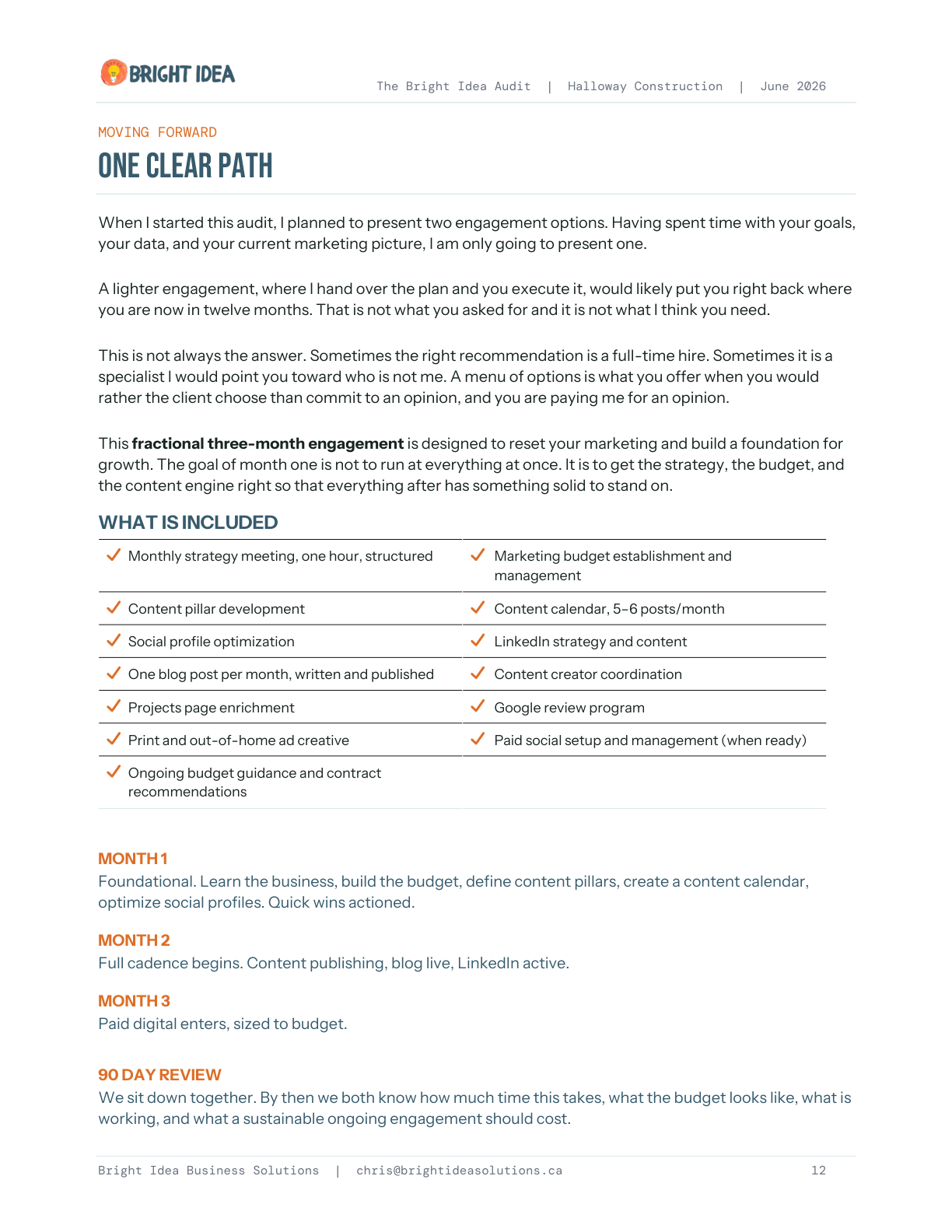
I went into this audit planning to present two engagement options. Having seen the data, only one of them was honest, so that's the only one in the document.
Sometimes that recommendation is me. Sometimes it's a full-time hire, or a specialist I'd send you to instead. A menu of options is what you offer when you'd rather the client pick than commit to an opinion.
I'm paid for my opinion.
what you walk away with.
A full accounting of what your marketing costs and what it returns.
A ranked set of priorities. An honest recommendation on a defensible marketing budget and who should run it, even if that isn't me.
It's yours. It doesn't expire and it doesn't depend on hiring me.